Climate and the future / Japan vs elsewhere
· updated
Everywhere on Earth You Climb for Snow. Japan Is the One Place You Drive Toward the Sea.
Across 3,069 ski areas we measure, height and snowfall move together — +0.58 in France, +0.85 in Germany. In Japan the figure is +0.02. The reason is not that elevation stopped working.
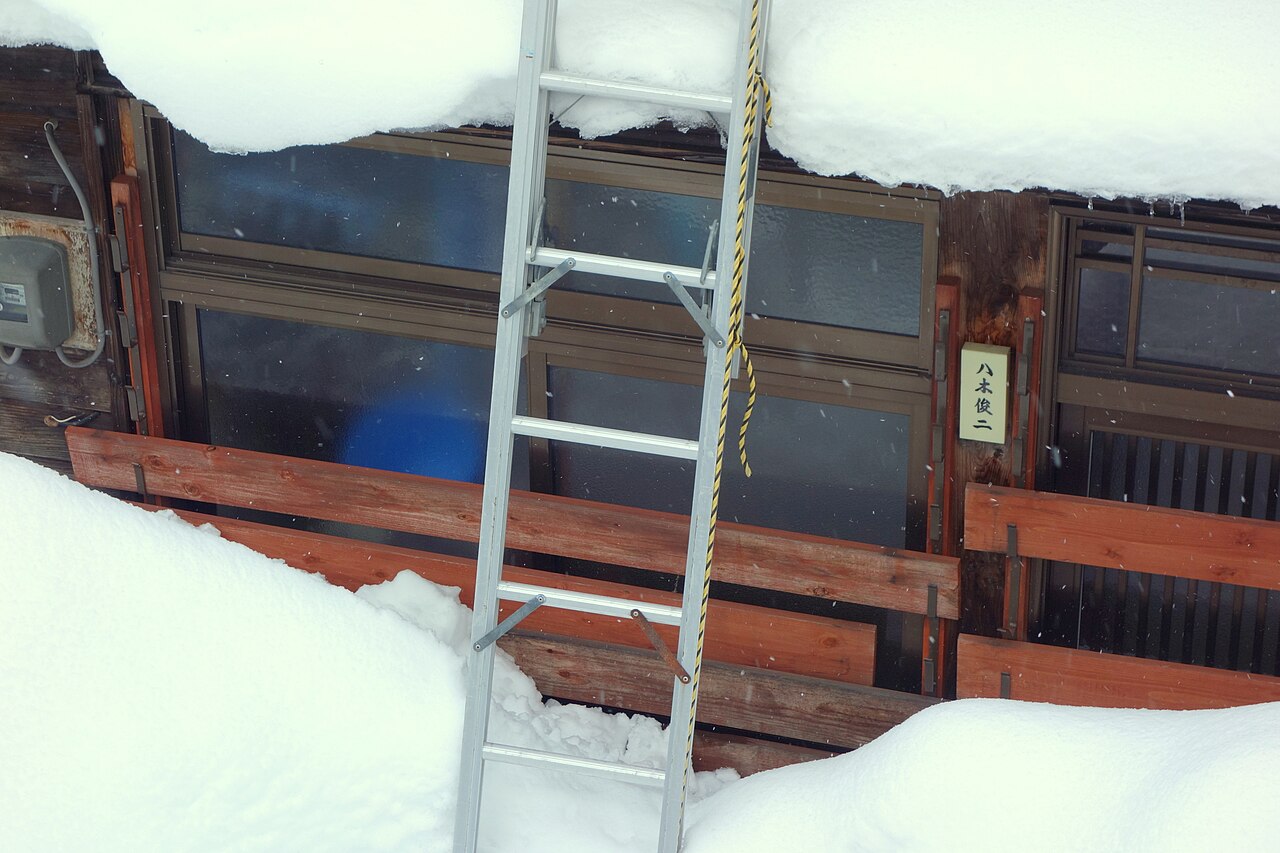
Every piece of ski advice ever written contains the same instruction: go higher. Book the resort with the higher base. Stay above the rain line. In a warming climate, altitude is the hedge everyone recommends.
We measured the elevation and the twelve-winter snowfall of 3,069 ski areas in 48 countries, the same way everywhere. The advice holds almost everywhere.
Height and snow move together — almost everywhere
Rank correlation between a ski area’s elevation and how much snow falls on it in a season:
| Ski areas | Correlation with seasonal snowfall | |
|---|---|---|
| Germany | 75 | +0.85 |
| Poland | 82 | +0.85 |
| Romania | 27 | +0.81 |
| Sweden | 69 | +0.69 |
| China | 181 | +0.60 |
| Switzerland | 283 | +0.60 |
| Slovakia | 87 | +0.59 |
| France | 244 | +0.58 |
| Iran | 22 | +0.57 |
| United States | 534 | +0.49 |
| Austria | 243 | +0.44 |
| Italy | 177 | +0.43 |
| Czech Republic | 57 | +0.38 |
| New Zealand | 26 | +0.38 |
| Finland | 52 | +0.32 |
| Norway | 135 | +0.19 |
| Canada | 171 | +0.08 |
| Japan | 397 | +0.02 |
| Spain | 34 | −0.27 |
Across all 3,069 at once the figure is +0.38. Spain is the one country where the relationship runs backwards, and it is a small sample: its highest resort, Sierra Nevada, is also its southernmost and only middling for snow (194 cm), while the snowiest Spanish areas sit lower in the Pyrenees. Among the big skiing countries, Japan and Canada are where height and snowfall barely move together, and Japan is the more extreme, with 397 areas and a figure of almost exactly zero. Put in metres, the exchange rate is steep in the Alps and flat to negative in Japan:
| Climbing 100 m changes seasonal snowfall by | |
|---|---|
| France | +13.5 cm |
| Switzerland | +9.2 cm |
| Austria | +7.3 cm |
| Italy | +6.5 cm |
| United States | +4.0 cm |
| Japan | 0.0 cm |
In France, a resort 1,000 m higher than its neighbour averages well over a metre more snow a season. In Japan, a resort 1,000 m higher averages the same.
Japan’s deepest snow sits at the bottom of the mountain
Split both regions into elevation bands and the shape of the difference appears.
| Elevation | Japan (median) | French, Swiss, Austrian and Italian Alps (median) |
|---|---|---|
| 0–500 m | 224 cm | — |
| 500–1,000 m | 290 cm | 153 cm |
| 1,000–1,500 m | 252 cm | 205 cm |
| 1,500–2,000 m | 250 cm | 248 cm |
| Above 2,000 m | — | 259 cm |
A dash means fewer than five ski areas in that band.
The Alps have to climb to 1,500 m to match what Japan gets at sea level. And Japanese snowfall peaks in the 500–1,000 m band and then falls away above it — the opposite of the pattern everywhere else.
Individual pairs make the point harder to dismiss. These are our own figures, measured identically:
| Elevation | Seasonal snowfall | |
|---|---|---|
| Sarufutsu village ski area, Hokkaido | 38 m | 215 cm |
| Nagaoka municipal ski area, Niigata | 161 m | 320 cm |
| Zermatt – Breuil-Cervinia, Switzerland | 2,990 m | 307 cm |
| Snow Park, Jungfraujoch, Switzerland | 3,439 m | 426 cm |
A municipal hill 161 metres above the sea in Niigata gets more snow than Zermatt – Breuil-Cervinia, which sits nearly three kilometres higher. One 38 metres up in northern Hokkaido gets 70% of it.
Niigata prefecture supplies most of the extreme cases. Every one of these is below 500 m:
| Ski area | Elevation | Seasonal snowfall |
|---|---|---|
| Yuzawa Park | 495 m | 712 cm |
| Itoigawa Seaside Valley | 478 m | 703 cm |
| Ishiuchi Hanaoka | 350 m | 695 cm |
| Ipponsugi | 410 m | 695 cm |
| Tainai | 294 m | 629 cm |
| Yakushi | 166 m | 532 cm |
Itoigawa Seaside Valley is close enough to the coast to have “seaside” in its name.
Japan’s zero does not mean elevation stopped working
This is the part that is easy to get wrong, and we nearly did.
Split Japan’s 397 areas by which sea they face, and the single national figure comes apart:
| Ski areas | Median elevation | Median snowfall | Correlation with elevation | |
|---|---|---|---|---|
| Sea-of-Japan side | 211 | 416 m | 249 cm | +0.38 |
| Inland | 118 | 1,250 m | 251 cm | −0.04 |
| Pacific side | 68 | 842 m | 244 cm | −0.16 |
On the Sea-of-Japan side, elevation behaves the way it does everywhere else. Snowfall climbs steadily with height:
| Sea-of-Japan side | Ski areas | Median snowfall |
|---|---|---|
| Below 300 m | 78 | 215 cm |
| 300–600 m | 64 | 293 cm |
| 600–1,000 m | 53 | 324 cm |
| Above 1,000 m | 16 | 414 cm |
The national figure is close to zero because Japan’s snowiest ski areas are also among its lowest. The coast facing the Sea of Japan is buried and near sea level; the high interior of Honshu is drier. Average the two together and the within-region effect of elevation cancels out.
So the honest statement is not “elevation does not matter in Japan.” It is:
Elevation still buys you snow in Japan, but only after you have chosen the right side of the country. Choosing the side is worth far more than choosing the height.
Nothing equivalent is true in the Alps, where the mountains are inland and the moisture arrives already wrung out. There, height is the only lever available.
Why the sea does this
Cold air leaves Siberia and crosses the Sea of Japan. The sea is comparatively warm, so the air picks up moisture over a few hundred kilometres of open water and reaches Honshu and Hokkaido loaded and unstable. It does not need a 3,000 m wall to unload — the first ground it meets is enough.
That first ground is the coastal plain and the low hills behind it. By the time the air has crossed the spine of Honshu it is spent, which is why the inland areas in the table above sit at 1,250 m and still see no more snow than coastal hills a third of that height.
The Alps have no equivalent. Atlantic moisture crosses France before it arrives, and what reaches the high valleys has already fallen on something else. The mountain has to do the lifting itself, and lifting is what elevation is for.
What to do with this
If you are choosing a Japanese resort, stop screening on base elevation. It is close to uninformative nationally, and where it does inform, it is the weaker of the two signals. Look at which side of the country the resort is on first.
If you are choosing an Alpine resort, keep screening on elevation. +13.5 cm per 100 m in France is a real number and worth acting on.
If you are comparing the two, do not compare base elevations at all. A 400 m Japanese resort and a 400 m Austrian resort are not the same proposition, and the numbers above show by how much.
How this was measured
Snowfall is the twelve-winter mean from the ERA5 reanalysis, computed by us the same way for all 3,069 ski areas. The model runs well below what resorts publish. It smooths mountains across a coarse grid, so it understates mountain snowfall everywhere. That matters for the absolute centimetre figures and not for the comparisons here, because every area on this page was measured by the identical method. Rankings and correlations survive a uniform bias; individual numbers do not.
Elevation is the value of a digital elevation model at the centre point of each ski area, not the base or the summit. Correlations are Spearman rank correlations, which do not assume the relationship is a straight line. Countries with fewer than 20 ski areas are left out of the country table, because a correlation over a handful of points is not a measurement.
The three-way split of Japan is by prefecture: Hokkaido, Aomori, Akita, Yamagata, Niigata, Toyama, Ishikawa, Fukui, Kyoto, Tottori, Shimane, Hyogo and Yamaguchi count as the Sea-of-Japan side; Gunma, Nagano, Gifu, Tochigi, Shiga, Yamanashi, Nara and Saitama as inland; the rest as the Pacific side. Prefectures straddle watersheds, so a handful of areas sit on the wrong side of their label. The gap between +0.38 and −0.04 is far larger than that noise.
Sources: Open-Meteo historical weather data, based on the ERA5 reanalysis (Copernicus Climate Change Service).
Book the trip
We do not take bookings. These are the sites Japanese ski accommodation actually sits on.
Contains advertising. We may earn a commission on bookings made through Rakuten.
Keep reading
Other guides built from the same dataset.