Where the snow falls / Climate and the future
· updated
How Much Does Snow in Chile and Argentina Change From Winter to Winter?
Three of the world's thirty snowiest ski areas are in South America on our standard measure. Over twelve winters, the typical Chilean ski area's best winter was about four and a half times its worst and the typical Argentine one's three and a half — against 2.3 in Japan. Only Italy swings as hard as Chile.
The world’s snowfall ranking is a Japanese list. Of the 31 ski areas in the world’s top thirty (two tie at 30th), 22 are in Japan.
Two of the other nine are in South America — including the one directly behind Japan’s snowiest.
| World rank | Ski area | Snowfall | |
|---|---|---|---|
| 3 | Nevados de Chillán | 🇨🇱 Chile | 752 cm |
| =26 | Corralco | 🇨🇱 Chile | 649 cm |
| 47 | Caviahue | 🇦🇷 | 584 cm |
| 48 | Antillanca | 🇨🇱 | 577 cm |
| =95 | Chapelco | 🇦🇷 | 472 cm |
| =97 | Las Leñas | 🇦🇷 Argentina | 469 cm |
| =378 | Portillo | 🇨🇱 | 326 cm |
Ranks and snowfall are our standard twelve-winter averages.
On that measure Nevados de Chillán is the third snowiest ski area on earth, and the snowiest in South America by a wide margin.
But “average” is doing an enormous amount of work here
Over the last twelve winters, Las Leñas ranged from 196 cm to 1,034 cm — its best winter a little over five times its worst.
The 1,034 cm season came once; the next best, 808 cm, came in 2026. Take the 1,034 cm winter out and the remaining eleven average 417 cm, against the 469 cm in the table above. A single season is moving the headline figure by about a ninth.
Nevados de Chillán swings harder still: 188 cm one winter, 1,081 cm the next.
And it is a regional habit, not one mountain’s:
| Ski areas measured | Best winter ÷ worst | |
|---|---|---|
| Italy | 25 | 4.63 |
| Chile | 10 | 4.57 |
| New Zealand | 24 | 4.21 |
| Spain | 25 | 3.90 |
| Argentina | 13 | 3.69 |
| United States | 25 | 3.34 |
| Austria | 25 | 2.82 |
| Japan | 376 | 2.34 |
| Canada | 25 | 1.82 |
The Andes swing hard, but they are not the extreme. The typical Chilean ski area’s best winter of the twelve was about four and a half times its worst, and the typical Argentine one’s about three and a half; Japan’s was a little over twice. Italy swings about as hard as Chile, and New Zealand sits between Chile and Argentina. The full country table is here.
The famous ones are not the snowy ones
This will be familiar to anyone who has read what we found in Japan.
| Ski area | World rank | Snowfall | Elevation | |
|---|---|---|---|---|
| Las Leñas | 🇦🇷 | =97 | 469 cm | 2,600 m |
| Corralco | 🇨🇱 | =26 | 649 cm | 1,758 m |
| — | ||||
| Valle Nevado | 🇨🇱 | =579 | 278 cm | 3,200 m |
| Cerro Catedral | 🇦🇷 | =287 | 348 cm | 1,500 m |
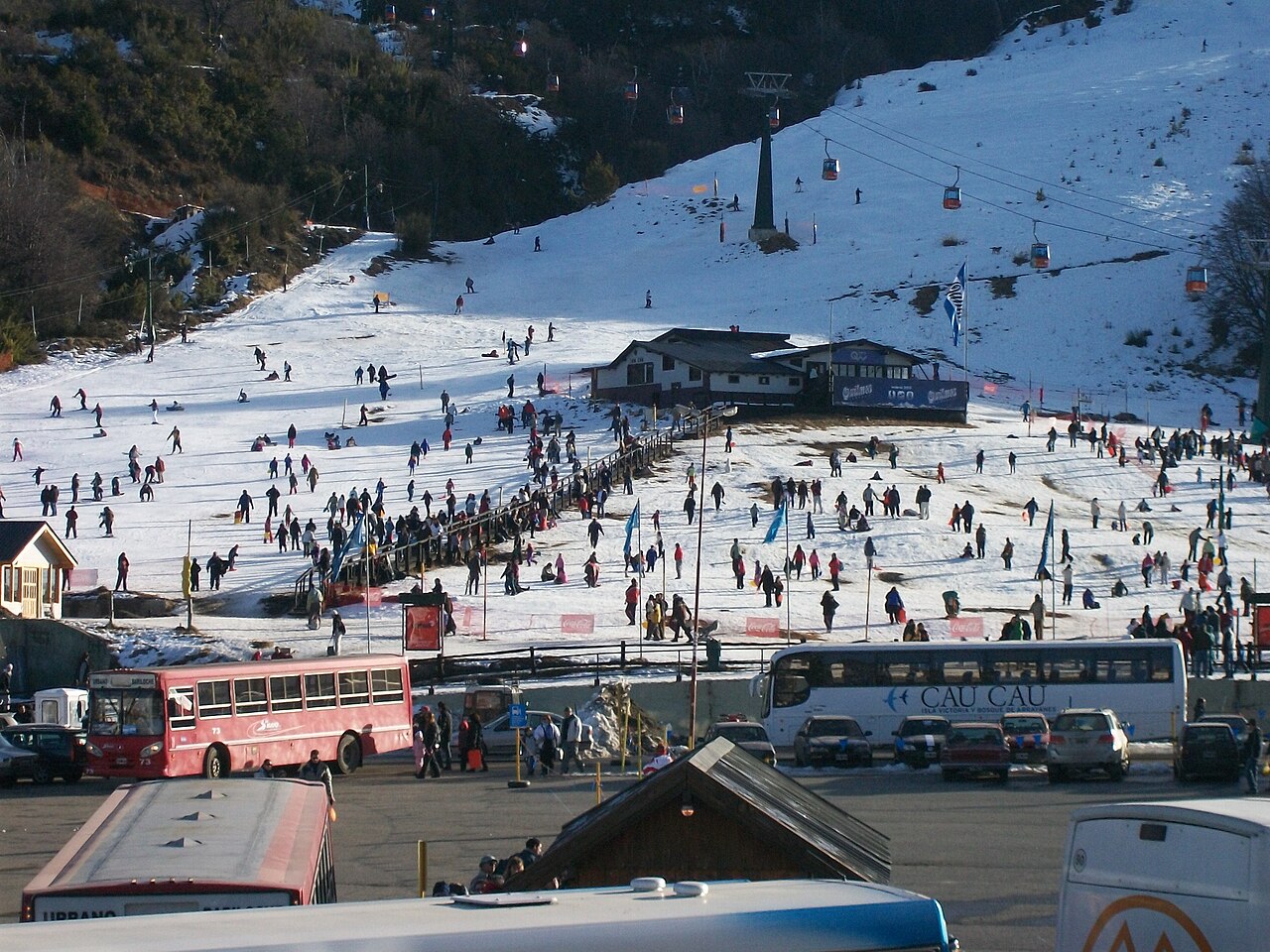
Cerro Catedral is the best-known ski area in South America and 287th in the world for snowfall. Valle Nevado, the name most overseas skiers associate with Chile, is 579th.
They are not badly chosen. Catedral sits above Bariloche, which is a real town with restaurants and an airport; Valle Nevado is 3,200 m up and an hour from Santiago. Those are infrastructure and access arguments, and they are good ones. They are not snowfall arguments, and nobody should confuse the two.
What this means if you are planning a trip
If your dates are fixed, weight elevation over headline snowfall. Where the best winter is about four times the worst, a season’s average tells you less than it would in Japan. Height is what protects what does fall: Valle Nevado at 3,200 m and Portillo at 3,000 m see rain on 2–3% of winter days, where the lower volcanoes further south see it on a third or more.
Do not book a fixed week expecting it to snow that week. The Andes record month by month is erratic: at Valle Nevado, four of the last twelve Julys brought less than 20 cm.
If you can move your dates, this is where the exceptional weeks are. High variance is only a risk when you are locked in, and the same spread that produced a 196 cm winter at Las Leñas produced a 1,034 cm one.
And book Las Leñas knowing which bet you are making. In a good year it is one of the snowiest ski areas on the planet. In a typical one it gets about 390 cm, on snow that almost never gets rained on. The 469 cm average describes neither.
How this was measured
The ranks and snowfall in the first and last tables are our standard twelve-winter averages from the ERA5 reanalysis, computed identically for all 3,069 ski areas, with the hemispheres offset so a southern winter is measured in its own season — June to September for South America, December to March for the north.
The swing figures use twelve winters — June to September 2015–2026 in the south, December to March 2014/15–2025/26 in the north — summed on Japanese calendar days, for up to 25 ski areas per country averaging at least 100 cm a season, picked by a fixed rule, and for all 376 such ski areas in Japan. Countries with fewer than ten measured ski areas are left out.
This article is why our standard figure changed. A three-winter average let one enormous winter lift a ski area far above its long-run average — Las Leñas by about a third (635 cm against 469 cm). On 28 September 2026 we moved the whole site to twelve-winter averages, and the rankings here are on that basis.
The model understates snowfall in mountains, and we can only check that against ground stations in Japan. South America has no equivalent check available to us, so treat the centimetres as indicative and the comparisons, which apply the same method everywhere — as the usable part.
Elevation is the figure mapped on OpenStreetMap for each ski area; where it differs from the height of the model’s grid point, we use it to correct the temperature. Twenty-four South American ski areas are in our data.
Sources: Open-Meteo historical weather data, based on the ERA5 reanalysis (Copernicus Climate Change Service); OpenSkiMap, map data © OpenStreetMap contributors (ODbL).
Revision history
- 13 September 2026. Rewritten on twelve winters. The three-winter version had Argentina swinging most and Chile steady; over twelve winters Chile swings more, 4.57 against 3.69.
Book the trip
We do not take bookings. These are the sites Japanese ski accommodation actually sits on.
Contains advertising. We may earn a commission on bookings made through Rakuten.
Keep reading
Other guides built from the same dataset.