Where the snow falls / Planning a trip
· updated
Togakushi: Deep, Dry Snow Inside Nagano City
Togakushi is inside the city limits of a place with about 370,000 people. Snow falls at −5.3 °C, rain arrives on 11% of winter days against a national median of 16%, and it has the best snow quality of any Japanese ski area within 20 km of a city.
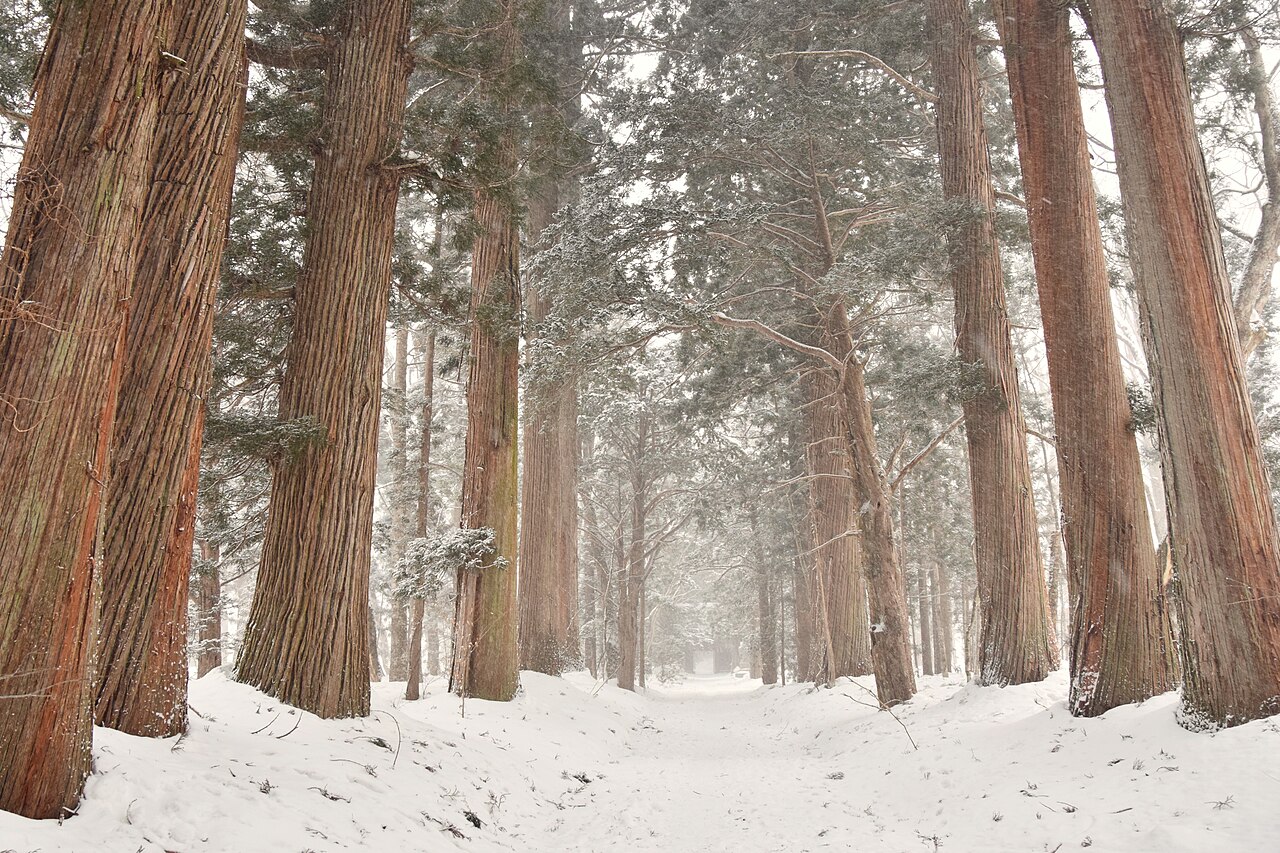
Of the 397 ski areas in Japan, eleven sit within 20 km of a city of 200,000 people or more. We rank all 397 by snow quality. The best of those eleven is Togakushi, and it is not close.
It is also, administratively, in Nagano City. The address is Togakushi, Nagano City — the same city as the station the Shinkansen arrives at, 12.3 km away.
The numbers
| Snow quality | 6th of 397 in Japan |
| Temperature when it snows | −5.3 °C |
| Rain days | 11% of winter days (national median 16%) |
| Days over 5 cm | 33% of winter |
| Wind on snowing days | 14.9 km/h |
| Snowfall | 553 cm — 34th in Japan, 61st in the world |
| Elevation | 1,205 – 1,561 m |
| Size | 3.3 km across |
| Places to stay | 8 |
| To Nagano station | 12.3 km |
Read the rain row twice. Eleven per cent. Across Japan the median ski area sees rain on 16% of the days something falls out of the sky, and the snowiest Japanese resorts are wetter still. Togakushi is drier than almost all of them while getting 553 cm.
Why a ski area this good is inside a city
Nagano City absorbed the surrounding villages, so the boundary reaches 12 km north-west into the mountains. That is an administrative accident, not a geographic one — nobody built a ski area in a suburb.
But the accident has a real consequence. Togakushi sits at 1,205 to 1,561 m, high enough to be cold, close enough to a Shinkansen station to be a day trip. Those two things almost never co-occur. The other ten ski areas within 20 km of a Japanese city rank 26th, 37th, 51st, 55th, 60th, 67th, 106th, 111th, 282nd and 297th for snow quality. Two of them are effectively city hills with wet snow.
Elevation is the whole reason, as it is almost everywhere in Japan. Togakushi’s base at 1,205 m is higher than the summit of 275 of Japan’s 391 measured ski areas — 70% of them.
What you actually get
553 cm and cold. Thirty-fourth in Japan for volume is genuinely a lot. Of the 963 ski areas we measure in Austria, Switzerland, France, Italy and Slovenia, the snowiest gets 486 cm — the Aiguille du Midi above Chamonix. Not one of them reaches Togakushi’s figure. And it arrives at −5 °C rather than the near-freezing wet snow that the biggest Japanese snowfall numbers usually describe.
Eight places to stay. This is a village, not a resort town. There is no chain rental shop and no English ski school as far as we can establish.
A camera that shows the slopes. Togakushi is one of the 91 Japanese ski areas out of 397 that publishes a live view of its own snow — most publish nothing but a government road camera. It also has two road cameras on the way up, which on a mountain road in Nagano in February is the picture you actually want first.
How to use it
Stay in Nagano city and come out for the day. This is the argument. Hotels, restaurants, a Shinkansen station and a normal city, with 553 cm of −5 °C snow 12 km up the road. Almost nowhere in the skiing world offers that combination; the closest equivalents are Sapporo’s local hills, which get less snow.
Or stay in the village if you want to be first on it. Eight properties is enough to sleep in and not enough to queue behind.
Do not expect a big mountain. At 3.3 km across and 356 m from bottom to top, Togakushi is small in the way most Japanese ski areas are small. What it has is the snow and the location, not the scale.
And it is a short hop from better-known neighbours. Iizuna Kogen and Kurohime Kogen are both nearby and both also within reach of Nagano — worth knowing if you are basing yourself in the city for several days rather than one.
How this was measured
Snow quality is our own index across all 397 Japanese ski areas: temperature on days snow falls, share of days over 5 cm, with penalties for rain days and wind. How much snow falls is deliberately not an input. Temperature is corrected to each ski area’s mid-elevation. The weights are our judgement rather than physics; what the ranking carries is that all 397 went through one identical calculation.
Snowfall is the twelve-winter mean from the ERA5 reanalysis, which understates snowfall in Japanese mountains — treat 553 cm as a floor and the rank as the reliable part.
“Within 20 km of a city” means straight-line distance to a place of 200,000 people or more, which is how our city-access ranking is built. Straight-line is not travel time, and in mountains the difference is large. Eleven Japanese ski areas qualify; the comparison above is against those eleven.
Elevation is sampled from the ground across the ski area’s mapped footprint, not taken from the resort’s own figures. Accommodation is properties mapped on OpenStreetMap within 12 km, counted as buildings rather than rooms.
Sources: Open-Meteo historical weather data, based on the ERA5 reanalysis (Copernicus Climate Change Service); OpenSkiMap, map data © OpenStreetMap contributors (ODbL).
Book the trip
We do not take bookings. These are the sites Japanese ski accommodation actually sits on.
Contains advertising. We may earn a commission on bookings made through Rakuten.
Keep reading
Other guides built from the same dataset.