Planning a trip / Japan vs elsewhere
· updated
How Much Vertical Do Japanese Ski Areas Have?
We sampled the terrain at 389 Japanese ski areas. A third span less than 200 m from their lowest measured point to their highest. And height and snowfall arrive together — you do not get to trade one for the other.
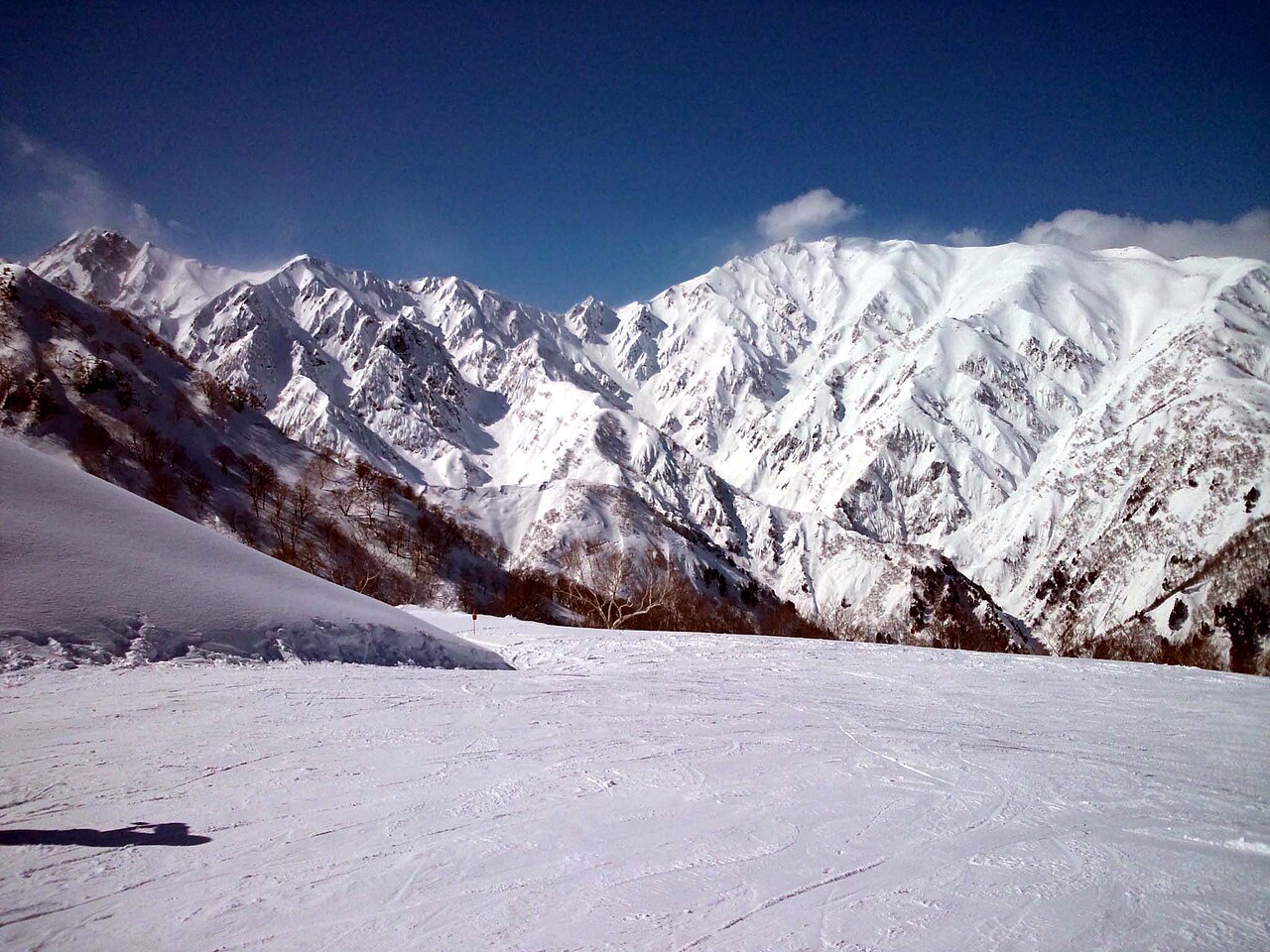
The photographs never tell you this one either. A skier chest-deep in trees says nothing about how far below them the bottom of the mountain is.
We sampled the ground at 389 Japanese ski areas. From the lowest point we measure to the highest, the middle one spans 277 metres.
A third of them fall less than 200 m
| Height span | Ski areas | |
|---|---|---|
| Under 200 m | 127 | 33% |
| 200–300 m | 82 | 21% |
| 300–500 m | 106 | 27% |
| 500–800 m | 66 | 17% |
| Over 800 m | 8 | 2% |
More than half of Japanese ski areas — 209 of 389 — span under 300 m. Eight have more than 800 m. That is the whole tail.
At 277 m, a top-to-bottom run is a couple of minutes of skiing. Not a bad couple of minutes, but if your mental picture of a ski day is dropping in at the summit and arriving at the village twenty minutes later, that day exists at eight ski areas in Japan.
The eight that do go big
| Ski area | Height span | Snowfall | |
|---|---|---|---|
| Hakuba Goryu & Hakuba47 | Nagano | 1,476 m | 414 cm |
| Ryuoo Ski Park | Nagano | 979 m | 405 cm |
| Hakuba Happo-One | Nagano | 960 m | 414 cm |
| Kagura Area | Niigata | 878 m | 542 cm |
| Arai Snow Resort | Niigata | 858 m | 663 cm |
| Hakuba47 | Nagano | 853 m | 668 cm |
| Nozawa Onsen | Nagano | 849 m | 450 cm |
| Tsugaike Kogen | Nagano | 834 m | 668 cm |
Six of the eight are in Nagano, and four of those six are in one valley. If you want a long descent in Japan, you are going to Hakuba or you are going to Niigata.
Height and snow arrive together
Here is the part that changes how you should plan.
| Ski areas | Median snowfall | |
|---|---|---|
| Spans over 500 m | 73 | 358 cm |
| Spans under 300 m | 209 | 202 cm |
| Spans under 200 m | 127 | 200 cm |
The tall ones get about 77% more snow than the short ones.
That is not obvious, and it is not what you might hope. A reasonable traveller’s instinct is that these are separate axes — that you could pick a small, quiet, low hill and still get buried, trading terrain for powder. Mostly you cannot. In Japan the two travel together, because both are produced by the same thing: being high enough, and on the right side of the mountains, for the sea-effect snow to reach you.
Arai is the clearest case in the table — 858 m of span and 663 cm a season. It is not choosing between them.
So what should you actually do
If you have one week and it is your only trip, go where the numbers are both high. The eight areas above are the short list, and Hakuba and Niigata are the two answers. You are not being unadventurous; you are being efficient.
If you are coming back, the short hills are where the value is. A 200 m hill with 200 cm a season is a genuinely good day, and it is empty, and it is cheap, and the lift is a chairlift you will not queue for. Japan has 127 hills under 200 m, and about half of them average 200 cm or more. This is the part of the country almost no overseas visitor sees.
And do not read a small span as a bad mountain. Two hundred and seventy-seven metres, repeated on fresh snow, is why people come back. We wrote separately about how small Japanese ski areas are and why it does not feel that way: the run is not the same run, because it snowed again.
How this was measured
This is not the vertical drop a resort publishes, and it is measured a different way. A resort quotes the longest lift-served descent. We take five points — the four corners of the ski area’s mapped footprint and its centre — look up the ground elevation at each, and report the range between the lowest and highest of those five. Elevations come from the Geospatial Information Authority of Japan.
That method has consequences worth knowing. It can read high where the mapped footprint includes ground the lifts do not reach — a ridge above the top station, or a valley floor below the base. It can read low where the true high and low points fall between the five samples. And it measures the ski area’s terrain, not any single run you can actually ski top to bottom.
What it is good for is comparing 389 places that were all measured identically. The shape of the distribution — a third under 200 m, eight over 800 m — is the finding. Any individual number carries the caveats above.
Snowfall is the twelve-winter mean from the ERA5 reanalysis, computed identically for every ski area. It runs low in Japanese mountains — we measured how low, so read the ratio between the rows, not the centimetres themselves.
Two more limits. This covers 389 of Japan’s 397 ski areas; eight have no usable elevation range. And Hakuba Goryu & Hakuba47 at 1,476 m is a linked pair measured as one footprint, which is why Hakuba47 also appears on its own in the table, and why its figure is the one to treat with most caution.
Sources: Open-Meteo historical weather data, based on the ERA5 reanalysis (Copernicus Climate Change Service).
Book the trip
We do not take bookings. These are the sites Japanese ski accommodation actually sits on.
Contains advertising. We may earn a commission on bookings made through Rakuten.
Keep reading
Other guides built from the same dataset.