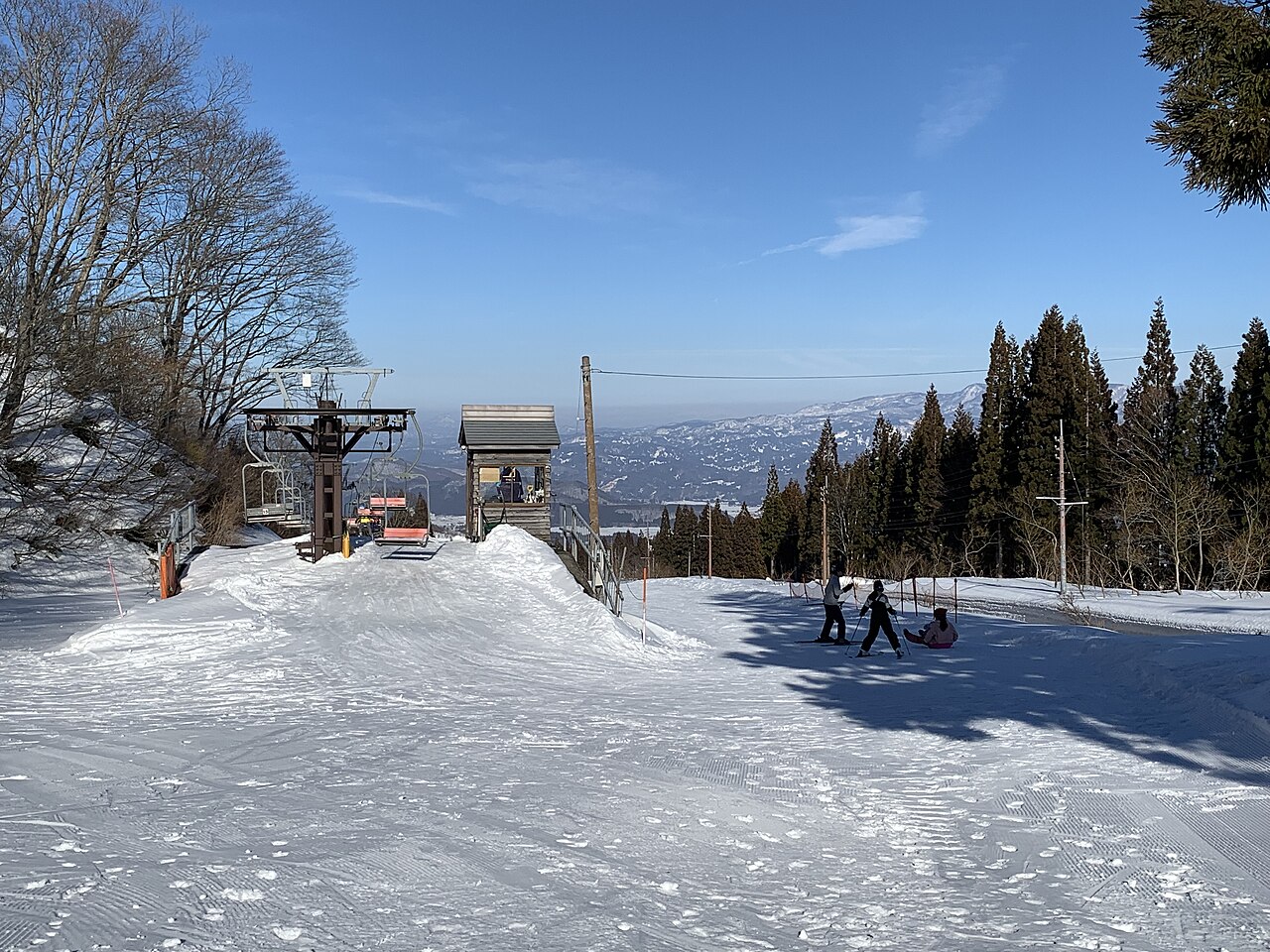
No snow yet. The 2026/27 season is planned to open on 19 Dec (the resort’s announcement; it moves with the snow). Snow depth and the seven-day outlook appear once snow is on the ground or forecast.
Opens
19 Dec
Typical snowfall
445cm
A weather-model figure, worked out the same way for every ski area, and lower than what actually falls. Use it to compare ski areas, not against the resort’s own totals. How we measure →
Elevation
722–878 m
Across
1.5 km
Kyukamura Myoko's hotel opens straight onto the slope, so guests can ski from the door. From the top of the lift, a walk of about ten minutes leads to the neighbouring Seki Onsen Ski Area, which needs its own lift ticket. Sources: qkamura.or.jp (sources read 12 Oct 2026; an AI draft the site operator has not yet checked)
How much snow it gets
Modelled from weather data the same way at all 3,069 ski areas we cover. These are not the resort’s own published figures.
Seasonal snowfall
445cm
per season
Worst of 12 winters
273cm
The middle winter of the 12: 452 cm. The best: 560 cm.
World rank
117
of 3,069 worldwide
Rank in country
58
of 397 in Japan
Elevation rank
181
Highest to lowest, of 397 in Japan. The centre point sits at 809 m, 43 m above the national median.
Quality rank
104
of 397 in Japan
Temp when snowing
−2.7°C
Japanese median: −3.6°C
Rain days
17%
Japanese median: 16%
Days over 5 cm
26%
Japanese median: 15%
Wind when snowing
13km/h
Average daily peak, 10 m above ground across a model grid cell; not the wind on ridges or lift tops
Dryness33
Frequency75
Freedom from rain57
Calm when snowing (model grid)100
The tick marks the median across every Japanese ski area we measure. All four bars run the same way — longer is better.
The quality score leaves out how much snow falls (it uses temperature, frequency, rain and wind).
Compared with what is nearby
Within 50 km in a straight line. Ski areas in the same weather-model cell (about 30 km across) get the same figure.
Official figures: longest 900 m, 100% beginner, 0% intermediate, 0% advanced. Source (checked 4 Oct)
When it falls, and how winters differ
Month by month
The most snow falls in January. March brings 42% of January’s snowfall. That is a steeper fall than the median for ski areas in Japan (52%): the snow here is concentrated early in the season. For skiing, though, the amount matters more than the share: March brings 64 cm, more than the median of 46 cm.
126cmDec
154cmJan
102cmFeb
64cmMar
Average snowfall by month, last 12 winters
Winter by winter
Across the 12 winters measured, the average is 445 cm, and 5 of them fell short of it. The leanest was 2015/16 with 273 cm; the biggest was 2021/22 with 560 cm (2.1 times as much).
Total snowfall from December to March recorded at the 信濃町 weather station — 11.6 km from this ski area, 135 m below its mid-slope.
Three-season average
545 cm
2023/24
550 cm
2024/25
683 cm
2025/26
403 cm
The figure calculated on this page is 466 cm.
A weather station is not a ski slope. We picked one at a similar elevation, but it stands in a valley or a village. More snow falls on the mountain above it. We have not tried to guess how much more.
Source: Japan Meteorological Agency historical records
Hot springs nearby, as analysed
5 hot spring sources with published analyses lie within 5 km of this ski area, nearest first (the hottest is 53.5 °C).
Show the sources
Source
Distance
Temperature
pH
Type
関河原湯
0.9 km
52℃ hot
6.7 neutral
—
白滝白瀧温泉
2.7 km
—
—
simple
燕北地獄谷
3.1 km
47.5℃ hot
6.7 neutral
—
赤倉・新赤倉元湯
4.1 km
53.5℃ hot
6.4 neutral
simple
新妙高新妙高
4.1 km
28℃ lukewarm
6.6 neutral
—
These are analyses of hot spring sources, not a list of baths you can visit. They date from 1910 to 2005, many from decades ago, so today’s temperature and chemistry may differ. Names are as recorded in Japanese. Temperature and pH bands follow Japan’s standard for analysing hot springs.
Source: processed from the hot spring analysis data in the Geothermal Information Database (GRES-DB), Geological Survey of Japan, AIST
Worth seeing nearby
Within 20 km in a straight line, nearest first. Some lie over a pass that is closed in winter.
Chosen from the places most read about on Wikipedia, favouring those with an English article. Based on the Japanese Wikipedia lists of sights in each prefecture, as compiled in travel-log-data (CC BY-SA 4.0). English names from Wikidata (CC0). The content of this section is available under CC BY-SA 4.0.
Map
The weather map, and where it sits among nearby ski areas.
Sekiyama Station (Echigo TOKImeki Railway Myoko Haneuma Line): about 15 minutes by the hotel's courtesy bus (reservation required by the previous day)
By car
about 20 minutes from Nakago IC, or about 30 minutes from Myoko-Kogen IC (Joshin-etsu Expressway)
Winter roads
Winter 2026-27 courtesy bus planned from 19 December 2026 to 1 March 2027: departs Sekiyama Station 10:35 and 15:25, departs the hotel 10:00 and 15:00. No pick-up from Joetsumyoko Station
Source: qkamura.or.jp · checked 1 Nov 2026. Shuttle days and times change with the season; check the official site before you go.
Pick dates and guests to check rooms on Rakuten Travel
Prices are the lowest Rakuten Travel lists; a property name, or “Pick dates and guests” above, shows prices and rooms for your dates.
Contains advertising. Property names and Rakuten Travel’s booking pages are in Japanese. · Property data by Rakuten Travel (Supported by Rakuten Developers)
Places to stay on the map
2 places within 12 km of the slopes, as mapped on OpenStreetMap, many of them small inns and pensions. Many are not on booking sites — open the name for the website or the map.
Hakuba Happo-One opened early-bird sales at 10:00 on 1 October. A day costs ¥6,400 against ¥9,800 at the window, 35% off. But every ticket on the list except one needs a My Number Card and a Japanese phone app. A visitor from abroad can buy exactly one of them, at 15% off.