Where the snow falls / Climate and the future
· updated
Nevados de Chillán: South America's Snowiest Ski Area, and Why Its Snow Is Wet
Nevados de Chillán gets 752 cm a season, 3rd of the 3,069 ski areas we measure and the most in South America by a distance. Its snow falls at an average of +0.3 °C, which is the catch, and its winters run from 188 cm to 1,121 cm.
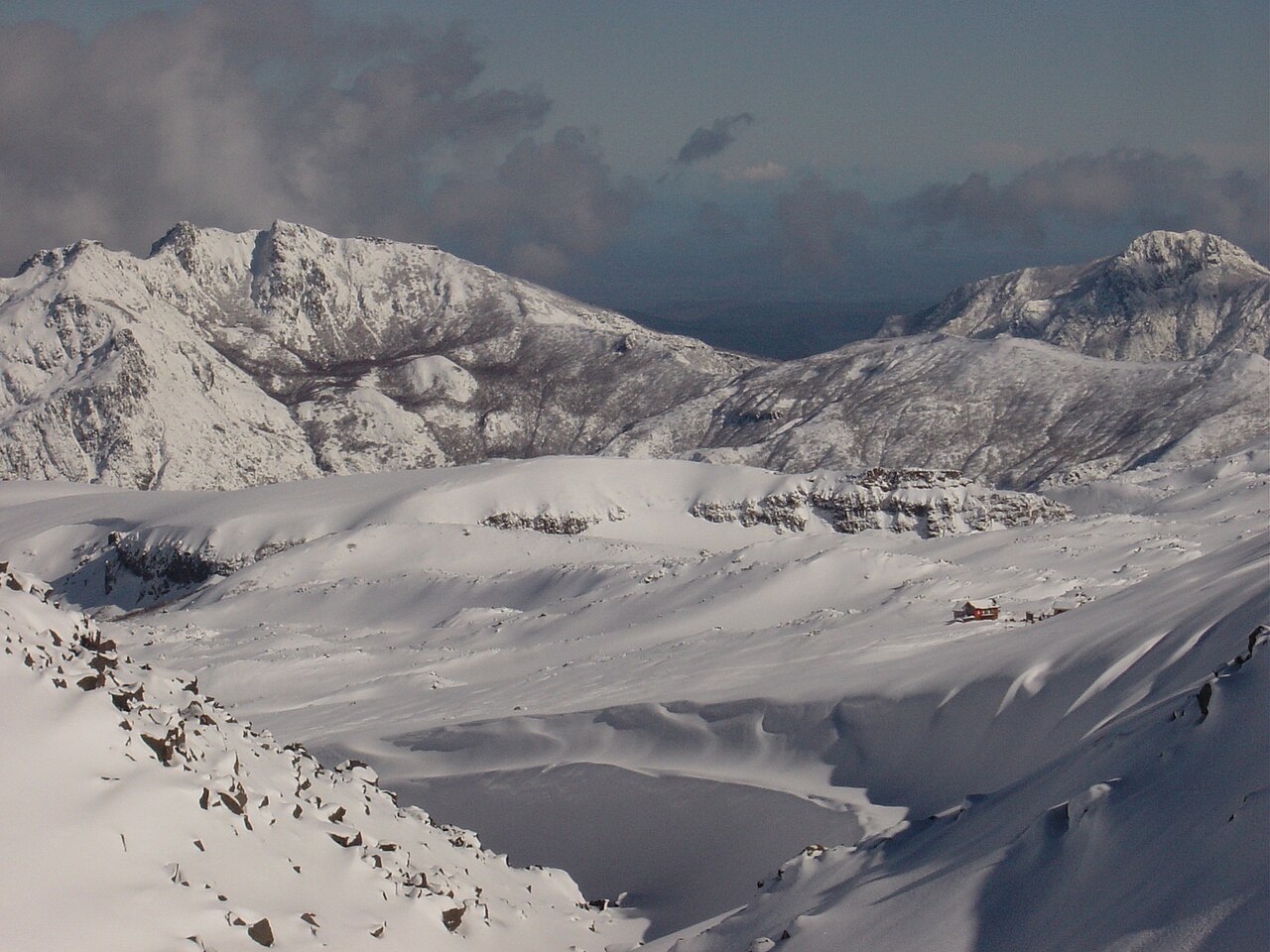
We measure snowfall the same way at 3,069 ski areas. Here is the top of that list.
| Ski area | Snowfall | ||
|---|---|---|---|
| 1 | FONNA Glacier | 🇳🇴 | 783 cm |
| 2 | Okutadami Maruyama | 🇯🇵 | 765 cm |
| 3 | Nevados de Chillán | 🇨🇱 | 752 cm |
| 4 | Shames Mountain | 🇨🇦 | 730 cm |
| 5 | Muikamachi Hakkaisan | 🇯🇵 | 728 cm |
| =6 | Iwappara and three other Yuzawa areas | 🇯🇵 | 712 cm |
| 10 | Ski Callaghan | 🇨🇦 | 710 cm |
Two ski areas on earth get more snow than Nevados de Chillán — a Norwegian glacier and a Japanese hill — and both stay shut for most of the winter because their access roads are buried. Chillán is the snowiest ski area on earth that runs through its own winter.
It swings harder than almost anywhere in the Andes
Deep snowfall in the Andes usually comes with wide swings between winters, and Chillán is no exception. Over the last twelve:
| Worst winter | Best winter | Best ÷ worst | |
|---|---|---|---|
| Nevados de Chillán 🇨🇱 | 188 cm | 1,121 cm | 6.0× |
| Las Leñas 🇦🇷 | 196 cm | 1,034 cm | 5.3× |
| Corralco 🇨🇱 | 261 cm | 904 cm | 3.5× |
| Okutadami Maruyama 🇯🇵 | 381 cm | 989 cm | 2.6× |
Its best winter was six times its worst. The worst, 188 cm in 2016, was followed straight away by 1,081 cm in 2017, and the best, 1,121 cm, came this year.
Its twelve-winter average is 752 cm — still one of the deepest figures we measure anywhere, but it is an average of very different seasons. Okutadami Maruyama, the one Japanese ski area ahead of it, has a lower ceiling and a floor twice as high. If you can move your dates, Chillán’s good winters are among the biggest on earth. If you cannot, it is a much riskier booking than its average suggests — the Andes record month by month is erratic.
The catch is the temperature
Snowfall totals do not tell you what the snow is like. We measure that separately, and here the two measurements disagree completely.
| Snowfall rank | 3rd of 3,069, and 1st in South America |
| Snow-quality rank | 340th of 456 |
| Average temperature when snow falls | +0.3 °C |
| Days with rain | 22% |
The average snowfall day at Nevados de Chillán is above freezing. Snow falling at +0.3 °C is heavy and wet, it consolidates fast, and more than one winter day in five brings rain instead.
This is what the Chilean lake district does. These are volcanoes a short distance from the Pacific, and the same ocean air that delivers extraordinary quantities of precipitation delivers it warm. Corralco, =26th in the world for snowfall, is 249th for quality on the same measurement. The pattern is regional, not a quirk of one mountain.
For comparison, the dry central Andes 400 km north — Portillo, Valle Nevado, El Colorado — get less than half as much snow and see rain on 2–3% of winter days.
What this is actually worth
If you want volume in the southern winter, nothing else on the continent matches it, and it is not crowded. 752 cm a season on a volcano with lifts, and no English encyclopedia entry to its name.
Do not expect Hokkaido snow. At +0.3 °C you are skiing heavy, dense snow that sets up quickly. That is a different sport from what the Japan footage shows, and it is worth deciding which one you are booking.
Go high on the mountain. Our figure describes the resort’s base elevation at around 1,700 m. The complex rises well above that, and every 100 m of height is worth roughly 0.65 °C — which, at an average of +0.3 °C, is the difference between wet snow and dry.
And if you are choosing between Chile’s regions, they are two different countries as far as snow goes. The lake-district volcanoes have the depth. The central Andes above Santiago have the quality. We ranked them all.
How this was measured
Snowfall is the twelve-winter mean from the ERA5 reanalysis, computed identically for all 3,069 ski areas, with the southern winter measured June to September. The model understates mountain snowfall — against 63 Japanese ground stations it returns about 56% of what they record, so 752 cm is a floor rather than a measurement, and the ranking is the part that carries.
One limit deserves stating plainly, because it is large here. A reanalysis grid cell is roughly 30 km across, and the figure a ski area gets depends heavily on the elevation the model assigns its cell. Chillán’s cell sits at 1,700 m. Sample the model 5 km south, where the cell sits at about 1,300 m, and it returns 426 cm instead of 752. Sample 8 km east, at about 2,100 m, and it returns 857 cm.
We use the point at the ski centre itself, and the elevation the model reports there matches the resort’s base. That is the correct choice and it is the same choice we make everywhere. But a top-three finish built on one grid cell is more fragile than a second-place finish would sound, and you should read it as “this is one of the snowiest ski areas on earth” rather than as a precise position.
Three winters is a short record, and here it misled us. The three winters behind the old 780 cm average happened to land close together, which is why an earlier version called Chillán steady. The swing figures above use twelve winters, summed on the same Japanese calendar days as the rest of the site.
The snow-quality measure combines temperature on snow days, how often 5 cm or more falls, how often it rains instead, and wind, multiplied rather than added. The weightings are our judgement, not a result. Temperature is corrected for elevation elsewhere in that dataset; at Chillán no correction applies, because the model’s elevation and the ski area’s are the same. Our quality measurement covers 456 ski areas — the 397 in Japan and 59 below the equator, so a rank out of 456 is a position within that set, not a world ranking.
Sources: Open-Meteo historical weather data, based on the ERA5 reanalysis (Copernicus Climate Change Service).
Revision history
- 29 September 2026. On twelve winters Nevados de Chillán is 3rd in the world rather than 2nd, and the title changed to match.
- 13 September 2026. An earlier version called Chillán steady, on three winters of 666 to 849 cm. Over twelve winters it ranges from 188 to 1,121 cm, and that section was rewritten.
Book the trip
We do not take bookings. These are the sites Japanese ski accommodation actually sits on.
Contains advertising. We may earn a commission on bookings made through Rakuten.
Keep reading
Other guides built from the same dataset.