Where the snow falls / Planning a trip
· updated
Where to Ski in July and August: Argentina Has the Deepest Snow of Any Country on Earth, and Everyone Books New Zealand
Argentina's median ski area gets 348 cm a season — more than Japan's 249 cm, and the highest median of any country we measure with ten or more ski areas. New Zealand's median is 144 cm. The English-language northern-summer ski trip points at the wrong hemisphere's end.
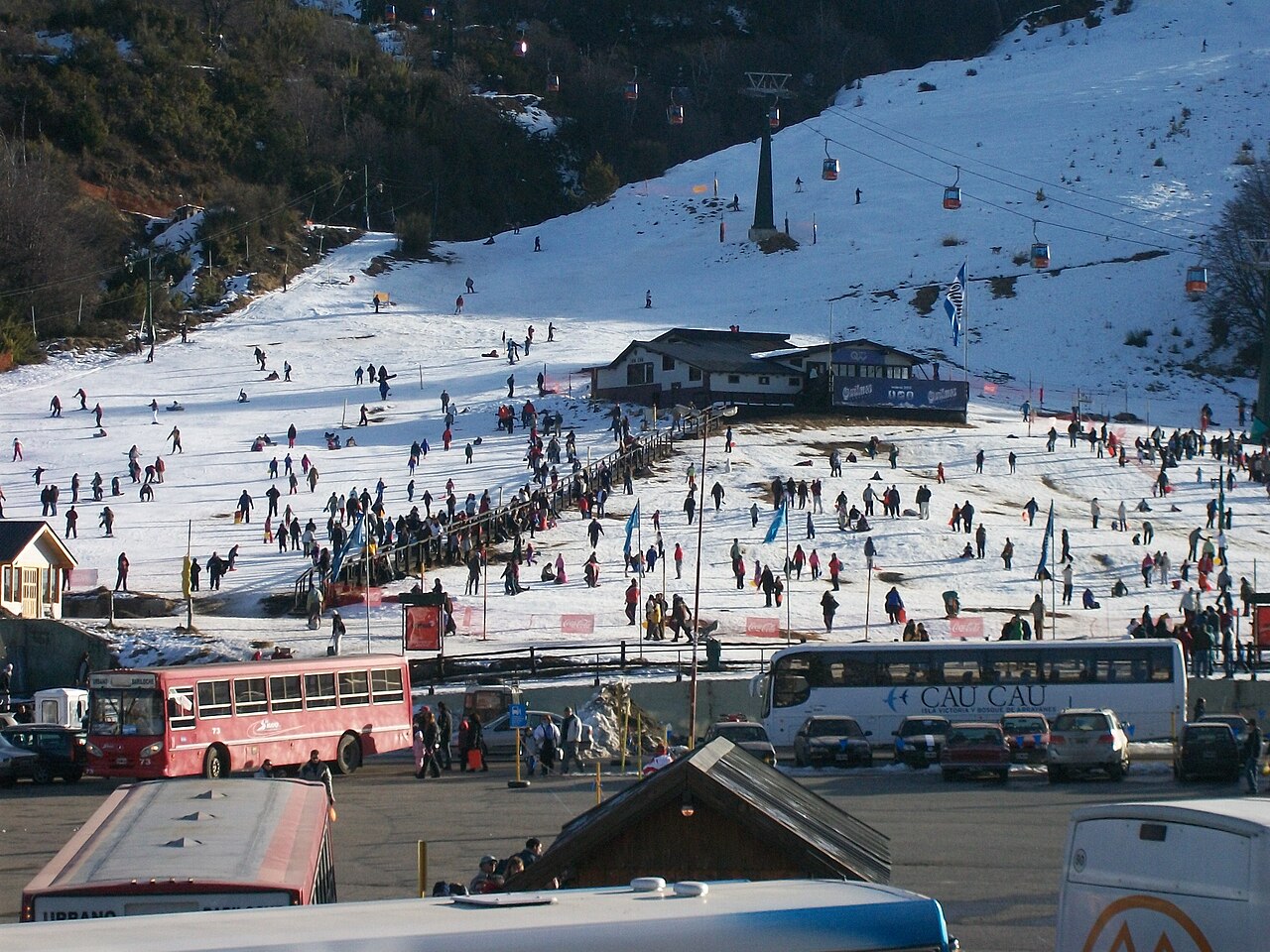
If you want to ski in July, the northern hemisphere is closed and you have four realistic countries: Argentina, Chile, New Zealand and Australia.
Here is what falls on each of them.
| Ski areas | Median snowfall | |
|---|---|---|
| 🇦🇷 Argentina | 13 | 348 cm |
| 🇨🇱 Chile | 11 | 326 cm |
| 🇦🇺 Australia | 10 | 168 cm |
| 🇳🇿 New Zealand | 26 | 144 cm |
The Andes get about twice what the antipodean fields get — Argentina’s median is 2.4 times New Zealand’s. And of the four, the two that dominate English-language coverage of the northern summer are the bottom two.
Argentina’s median beats every country we measure
Rank every country with ten or more ski areas by what its typical ski area receives:
| Ski areas | Median | ||
|---|---|---|---|
| 1 | 🇦🇷 Argentina | 13 | 348 cm |
| 2 | 🇨🇱 Chile | 11 | 326 cm |
| 3 | 🇨🇭 Switzerland | 283 | 253 cm |
| 4 | 🇯🇵 Japan | 397 | 249 cm |
| 5 | 🇦🇹 Austria | 243 | 226 cm |
| 6 | 🇫🇷 France | 244 | 220 cm |
| 7 | 🇮🇷 Iran | 22 | 204 cm |
| 8 | 🇳🇴 Norway | 135 | 203 cm |
| 9 | 🇪🇸 Spain | 34 | 184 cm |
| 10 | 🇮🇹 Italy | 177 | 181 cm |
| 11 | 🇹🇷 Turkey | 11 | 178 cm |
| 12 | 🇦🇺 Australia | 10 | 168 cm |
| 13 | 🇩🇪 Germany | 75 | 157 cm |
| 14 | 🇨🇦 Canada | 171 | 147 cm |
| 15 | 🇳🇿 New Zealand | 26 | 144 cm |
| 16 | 🇰🇬 Kyrgyzstan | 12 | 138 cm |
| 17 | 🇺🇸 United States | 534 | 132 cm |
Argentina is first and Chile is second — the two Andean countries sit above every northern-hemisphere ski nation. The typical Argentinian ski area gets 40% more snow than the typical Japanese one and more than two and a half times the typical American one.
Thirteen ski areas is a small sample and you should hold this loosely. A median built from thirteen numbers moves if two of them are wrong. But it is not a fluke of one outlier — six of Argentina’s thirteen ski areas are in the world’s top 200, and the country’s median being this high means the depth runs through the middle of the list rather than sitting at the top of it.
The southern hemisphere in order
All 60 ski areas we cover below the equator, top twenty:
| Ski area | Snowfall | World rank | ||
|---|---|---|---|---|
| 1 | Nevados de Chillán | 🇨🇱 | 752 cm | 3 |
| 2 | Corralco | 🇨🇱 | 649 cm | =26 |
| 3 | Caviahue | 🇦🇷 | 584 cm | 47 |
| 4 | Antillanca | 🇨🇱 | 577 cm | 48 |
| 5 | Cerro Perito Moreno | 🇦🇷 | 476 cm | =93 |
| 6 | Chapelco | 🇦🇷 | 472 cm | =95 |
| 7 | Las Leñas | 🇦🇷 | 469 cm | =97 |
| 8 | Batea Mahuida | 🇦🇷 | 437 cm | =122 |
| 9 | Invincible Snowfields | 🇳🇿 | 392 cm | =190 |
| 10 | Cerro Bayo | 🇦🇷 | 387 cm | 197 |
| 11 | Cerro Catedral | 🇦🇷 | 348 cm | =287 |
| 12 | Chapa Verde | 🇨🇱 | 332 cm | =345 |
| 13 | Lagunillas | 🇨🇱 | 328 cm | =363 |
| 14 | Portillo | 🇨🇱 | 326 cm | =378 |
| 15 | Los Puquios | 🇦🇷 | 314 cm | =430 |
| 16 | Pucón | 🇨🇱 | 301 cm | =476 |
| 17 | Los Penitentes | 🇦🇷 | 300 cm | =482 |
| 18 | Ōhau | 🇳🇿 | 290 cm | =521 |
| 19 | Fox Peak | 🇳🇿 | 285 cm | =545 |
| 20 | Treble Cone | 🇳🇿 | 282 cm | =561 |
Valle Nevado, El Colorado and La Parva share one grid cell at 278 cm and come next, 21st to 23rd.
Sixteen of the top twenty are in the Andes and the other four are in New Zealand. Australia does not appear at all: its best field, Charlotte Pass at 219 cm, is 26th in the southern hemisphere and =966th in the world.
What happened to Queenstown
Queenstown is the southern hemisphere’s ski capital in every sense that matters commercially — flights, beds, restaurants, a season’s worth of English-language marketing. Its two main fields:
| Snowfall | World rank | |
|---|---|---|
| The Remarkables | 142 cm | =1,775 |
| Coronet Peak | 116 cm | =2,148 |
Coronet Peak, the field in most photographs of New Zealand skiing, is =2,148th of 3,069. The world median is 161 cm: both Queenstown fields sit below it.
This is the same pattern we found among the world’s famous resorts generally and in Japan: the places that got developed were chosen for access, not for snow. Coronet Peak is 25 minutes from a town with an international airport. That is an excellent reason to build a ski field there and not a claim about precipitation.
New Zealand’s snow is real, but it is not where the infrastructure is. The country’s snowiest ski area is Invincible Snowfields at 392 cm, a small operation near Glenorchy with no website we could find. Treble Cone, at 282 cm and =561st in the world, is the snowiest New Zealand field a visitor is likely to have heard of — Ōhau (290 cm) and Fox Peak (285 cm) sit just above it — and it is two hours from Queenstown, in the Wanaka direction. The country’s snow and the country’s ski industry are not in the same place.
What to do with this
If you are travelling for snow depth, go to the Andes. Argentina and Chile hold sixteen of the southern hemisphere’s twenty snowiest ski areas, and the top of that list — Nevados de Chillán at 752 cm — is third in the world.
If you are travelling in July for other reasons, New Zealand is still a good trip and you should manage the snow expectation. Queenstown gives you a proper town, short transfers, and a country worth being in. What it does not give you is depth, and the marketing will not tell you that.
Weight elevation heavily in the south. Andes snowfall swings widely between good and bad winters — over twelve winters, the typical Chilean ski area’s best winter was about four and a half times its worst and the typical Argentine one’s three and a half, against about twice for the best-known Japanese resorts. Height is what protects you in a thin year, which is why Portillo at 3,000 m and Valle Nevado at 3,200 m stay operable when lower fields struggle.
And check what “resort” means before you book. Several of the snowiest names above are small. Ōhau at 290 cm covers 1.87 km end to end; Invincible has no lift infrastructure of the kind a destination skier expects. Snowfall rank is one column, and it is not the same question as whether there is a mountain’s worth of skiing under it.
How this was measured
Snowfall is the twelve-winter mean from the ERA5 reanalysis, computed identically for all 3,069 ski areas, with the hemispheres offset so a southern winter is measured June to September and a northern one December to March. Ranks are world ranks among all 3,069.
Country medians are only as good as the count beside them. Argentina’s 348 cm rests on thirteen ski areas and Chile’s on eleven — both only just clear the ten-ski-area floor we require for the ranking table. Japan’s 249 cm rests on 397. Treat the first as a strong indication and the last as a measurement.
The model understates mountain snowfall. We checked it against 63 Japanese ground stations and it returns about 56% of what they record. No equivalent check exists for us in South America or New Zealand, so the centimetres below the equator should be read as indicative and the ordering, which applies one method everywhere — as the usable part. If the understatement is worse in isolated steep terrain, as it is in Japan, then the Andes figures are conservative.
Elevation is the figure mapped on OpenStreetMap for each ski area. Size is the greatest distance across the mapped area on OpenStreetMap, which is missing for some areas and is a rough proxy for scale rather than a measure of skiable terrain.
New Zealand’s 26 include one indoor slope, which our model correctly reports as receiving no snow, and Manganui on Mount Taranaki at 9 cm — a real club field on an isolated volcano, and very likely a case of the grid-cell problem described above rather than a mountain that gets no snow. Removing both raises New Zealand’s median from 144 cm to 148 cm.
Sources: Open-Meteo historical weather data, based on the ERA5 reanalysis (Copernicus Climate Change Service); OpenSkiMap, map data © OpenStreetMap contributors (ODbL).
Book the trip
We do not take bookings. These are the sites Japanese ski accommodation actually sits on.
Contains advertising. We may earn a commission on bookings made through Rakuten.
Keep reading
Other guides built from the same dataset.