Where the snow falls / Onsen
· updated
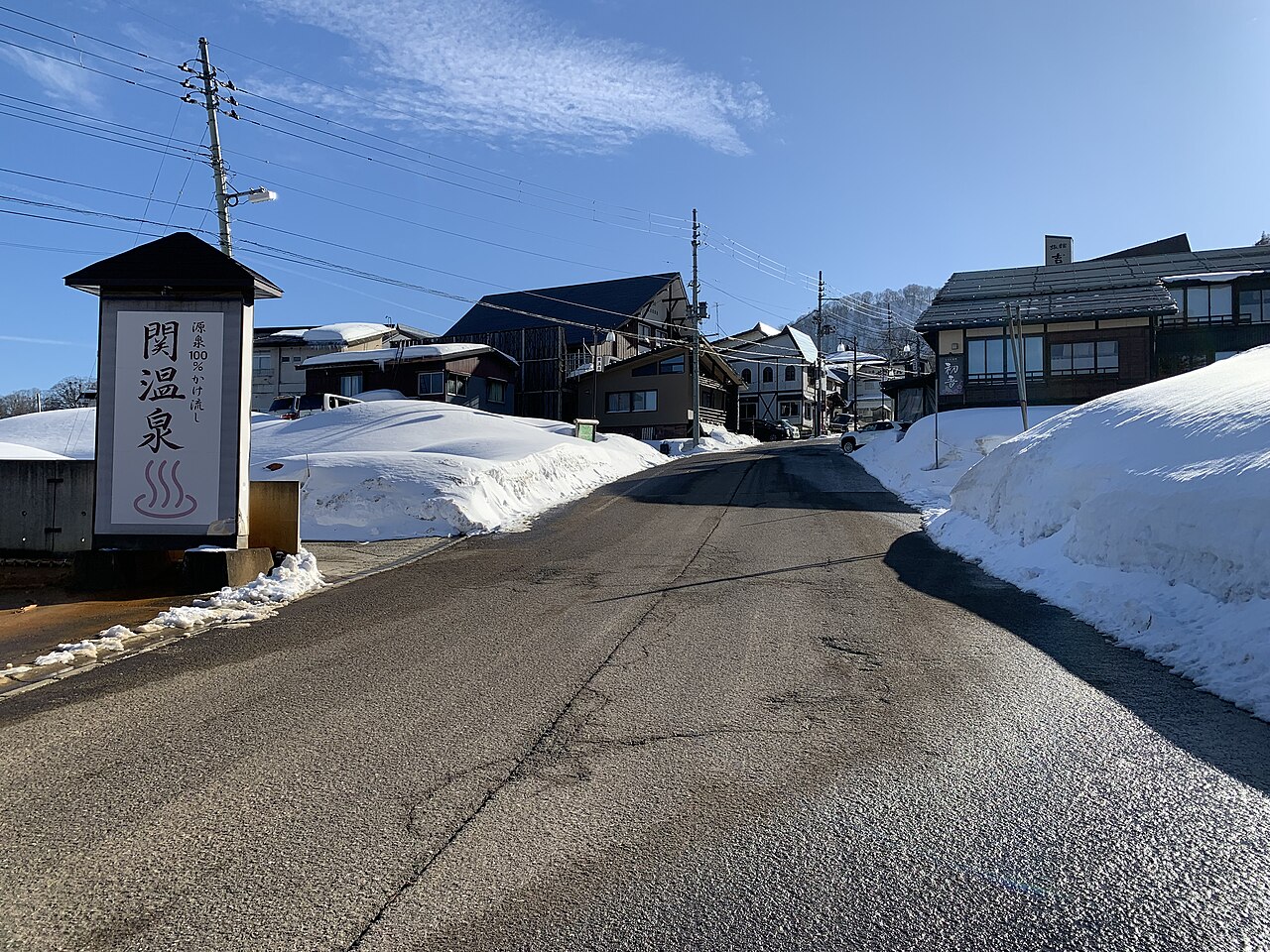
Seki Onsen in Myoko: How Much Snow, and What Is There
689 cm a season, 19th in the world. Only two ski areas in Europe get more and both are in Norway, one of which shuts all winter. Seki Onsen covers 1.17 km², and has two hotels within a kilometre.
We rank 3,069 ski areas worldwide by how much snow falls on them. Here is the top of that list.
| Ski area | Snowfall | ||
|---|---|---|---|
| 1 | FONNA Glacier | 🇳🇴 | 783 cm |
| 2 | Okutadami Maruyama | 🇯🇵 | 765 cm |
| 3 | Nevados de Chillán | 🇨🇱 | 752 cm |
| 4 | Shames Mountain | 🇨🇦 | 730 cm |
| 5 | Muikamachi Hakkaisan | 🇯🇵 | 728 cm |
| =6 | Iwappara, Yuzawa Nakazato, Nakazato Snow Wood, Yuzawa Park | 🇯🇵 | 712 cm |
| 10 | Ski Callaghan | 🇨🇦 | 710 cm |
| 11 | Itoigawa Seaside Valley | 🇯🇵 | 703 cm |
| =12 | Five ski areas around Ishiuchi and Yuzawa | 🇯🇵 | 695 cm |
| 17 | Eikedalen | 🇳🇴 | 693 cm |
| 18 | Charmant Hiuchi | 🇯🇵 | 690 cm |
| 19 | Seki Onsen | 🇯🇵 | 689 cm |
Six of the world’s ten snowiest ski areas are in Japan. Seki Onsen sits at 19th, a hot-spring hamlet on the side of Mount Myoko that almost nobody outside Japan has heard of. Only two ski areas in all of Europe get more snow than it, both in Norway, and one of those shuts for the whole winter because the road to it disappears. Against the Alps it is not close: the snowiest Alpine ski area we measure takes 486 cm.
What Seki Onsen is
| Snowfall | 689 cm a season, 14th in Japan and 19th in the world |
| Range across twelve winters | 273–867 cm |
| Snow quality | 30th of 397 in Japan |
| Temperature when it snows | −4.2 °C |
| Rain days | 17% of winter days |
| Height span | 859–1,139 m |
| Size | 1.2 km across — smaller than the Japanese median of 1.5 km |
| Places to stay | 2, both within 1 km |
| To a city | 28.5 km to Nagano |
Read the last three rows together. It gets more snow than anywhere in the Alps, it is under 30 km in a straight line from a city of about 370,000 people, and it has two hotels and no English-language page anywhere.
The snow is not a fluke of one winter
The most common reason a small ski area appears near the top of a snowfall ranking is that one freak season pulled its average up. That is not what happened here.
Across twelve winters, Seki Onsen’s middle winter was 732 cm. Nine of the twelve came in at 680 cm or more. The exception was 2015/16, which fell to 273 cm — but that was the winter that hit almost all of Japan at once, not something particular to Seki Onsen. Its best was 867 cm.
Put that typical winter against Europe. Only 33 European ski areas have had even one winter of 732 cm in those twelve years, 22 of them in western Norway and 11 in the French Alps. Seki Onsen does it in an ordinary year.
It also snows cold. −4.2 °C is the average temperature on days when snow falls, against a Japanese median of −3.5 °C, and rain falls on 17% of winter days against a national median of 16%. Neither figure is extraordinary on its own. What is unusual is having them alongside 689 cm — every Japanese ski area snowier than Seki Onsen snows warmer and rains more often.
Why here
Seki Onsen sits on the north-east flank of Mount Myoko, an active volcano on the Niigata–Nagano border. Cold air crossing the Sea of Japan picks up moisture, hits the first serious mountain inland, and is forced upward. Seki Onsen is on the receiving side of that, at 859 to 1,139 metres — high enough that what falls stays frozen, low enough that the road stays open.
Akakura is 1.5 km away — two ski areas with 57 places to stay between them, and the developed face of the same mountain. Seki Onsen is the same snow, a kilometre and a half up the road, without the buildings.
What “two places to stay” actually means
The Japanese median ski area has four places to stay nearby. Seki Onsen has two: Hanabun Onsen Hotel and Tsubame Highland Lodge, both within a kilometre.
Everything else on the mountain is closer to Akakura. There is no rental shop chain, no English ski school, no bus from the airport with your name on a clipboard. It is a hot spring with a ski lift, not a resort.
If that sounds like a warning, it is only half of one. The other half is that 689 cm falls on it either way.
How to think about going
This is a day trip from a base, not a destination in itself. Stay in Myoko or Akakura, where there are beds and food and a train station, and come to Seki Onsen for the snow. Akakura is 1.5 km away in a straight line — a short drive up the mountain road, though in this much snow “short” is doing some work.
Winter access is the real question, not the skiing. Seki Onsen is up a mountain road in the snowiest country on earth. The two live cameras we have for it are both on the roads in — which, on this mountain, is the more useful camera anyway.
And go for the snow, not the terrain. At 1.2 km across this is a small ski area even by Japanese standards, and Japanese standards are small to begin with. What it has is 689 cm falling on a modest hill, which is a specific kind of good day and not the same as a big mountain.
Why you have not heard of it
Seki Onsen is well known to Japanese skiers and barely written about in English. That is true of most of Japan’s snowiest ski areas, and we looked at why separately. A hot-spring hamlet with two hotels was never going to market itself abroad.
How this was measured
Snowfall is the twelve-winter mean from the ERA5 reanalysis, computed identically for all 3,069 ski areas on this site. The model understates snowfall in Japanese mountains — probably substantially here, so treat 689 cm as a floor and the ranking as the reliable part.
Snow quality is our own index: temperature when it snows, how often it snows, rain days and wind, with snowfall volume deliberately excluded so that it measures something different from the row above it.
Size is the distance corner to corner across the ski area as mapped on OpenStreetMap, not an area. Accommodation is hotels, ryokan and lodges mapped within 12 km, each counted once for whichever ski area it is nearest to, and counted as properties rather than rooms — in a hamlet this small the count is exact enough to name them. Distance to Nagano is straight-line, not travel time.
We deliberately do not publish run and lift counts for Seki Onsen. Our counting method takes everything mapped within a radius of the ski area’s centre, and at 2.5 km that radius reaches neighbouring ski areas on the same mountain. The figure it produces — dozens of runs — is not this ski area. Where a number would mislead, we leave it out.
Sources: Open-Meteo historical weather data, based on the ERA5 reanalysis (Copernicus Climate Change Service); OpenSkiMap, map data © OpenStreetMap contributors (ODbL).
Revision history
- 29 September 2026. On twelve winters Seki Onsen is 19th in the world rather than 9th, and its leanest winter was 273 cm. Nothing in the Alps gets as much snow, as before.
Book the trip
We do not take bookings. These are the sites Japanese ski accommodation actually sits on.
Contains advertising. We may earn a commission on bookings made through Rakuten.
Keep reading
Other guides built from the same dataset.